
Table of Contents
When people talk about blood sugar control, especially for diabetes, prediabetes, or metabolic health. two terms often come up: Glycemic Index (GI) and Glycemic Load (GL). They sound similar, but they measure different things.
If you want to understand how food affects your blood sugar — especially for diabetes, prediabetes, or metabolic health — you need to know the difference.
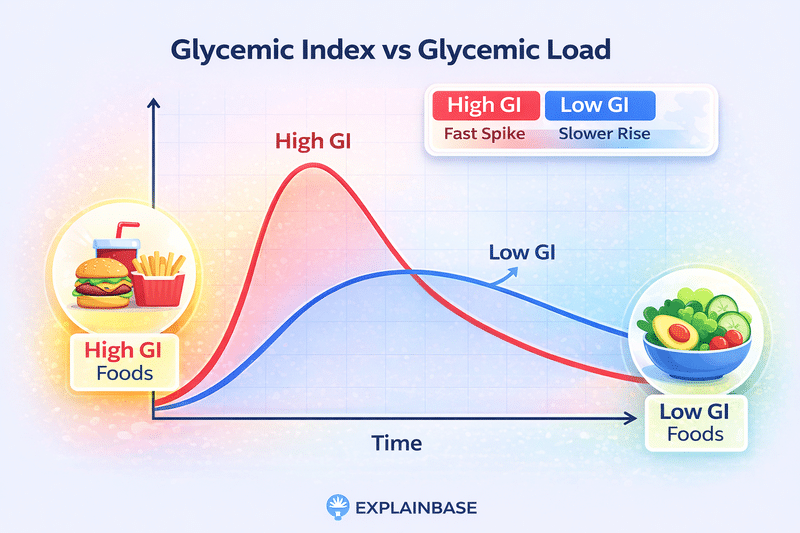
The Glycemic Index (GI) measures how quickly a carbohydrate food raises blood sugar levels. Glycemic Load (GL) considers both the Glycemic Index and the amount of carbohydrates in a typical serving. In simple terms, GI shows how fast sugar enters the bloodstream, while GL shows the overall impact of a portion of food on blood sugar.
Let’s break it down clearly.
What Is the Glycemic Index (GI)?
The Glycemic Index (GI) is a number that tells you how quickly a carbohydrate-containing food raises your blood sugar.
- Pure glucose has a GI of 100
- High GI foods raise blood sugar quickly
- Low GI foods raise blood sugar slowly
Only foods that contain carbohydrates are assigned a GI value. Foods like meat, eggs, and oils have no significant carbohydrates, so their GI is essentially zero.
For example:
- A white English muffin has a GI around 77
- A whole wheat English muffin has a GI around 45
This means the whole wheat version causes a slower rise in blood sugar compared to the refined white flour version.
The glycemic index was developed in the early 1980s to help people with diabetes choose foods that would not cause sharp blood glucose spikes. In testing, participants fasted and then ate a controlled portion of a specific food. Researchers measured how quickly their blood sugar rose compared to pure glucose.
But there’s an important limitation: GI measures a food by itself, not as part of a mixed meal.
What Is the Glycemic Load (GL)?
This is where things become more practical.
While GI measures how fast, Glycemic Load (GL) measures how much total impact a food has on blood sugar and the resulting insulin response.
Glycemic Load takes into account:
- The glycemic index of the food
- The amount of digestible carbohydrates in a typical serving
For example:
A cup of lentil soup may contain 30 grams of carbohydrates. However, about half of that is fiber, which is not digested into glucose. Only a small portion actually converts into sugar in the bloodstream. So even if the GI isn’t extremely low, the overall blood sugar impact may be modest.
Now compare that to cake:
An 80-gram serving of cake may contain 38 grams of carbohydrates, with 28 grams coming from sugar and very little fiber. Even if the GI were similar to another food, the total blood sugar impact would be much higher.
That difference is what Glycemic Load captures.
How Cooking Affects Glycemic Index
The way food is prepared can significantly change its glycemic index.
Cooking methods that break down carbohydrates can increase the GI value of a food. For example:
- Overcooked pasta has a higher glycemic index than al dente pasta.
- Mashed potatoes have a higher GI than boiled potatoes.
- Fruit juice raises blood sugar faster than whole fruit because the fiber is reduced.
Adding fiber, fat, or protein to meals can lower the overall glycemic response. For example, eating bread with peanut butter or avocado slows digestion and prevents rapid blood sugar spikes.
What is better: Glycemic Index or Glycemic Load?
Glycemic load is often considered more useful because it measures both the quality and quantity of carbohydrates in a serving of food. This provides a more realistic view of how food affects blood sugar levels.
Are low glycemic foods healthier?
Low glycemic foods may help maintain stable blood sugar levels, improve energy balance, and support long-term health. However, overall diet quality and nutrient content are still important.
Is glycemic index important for weight loss?
Foods with a low glycemic index may help people feel full longer and reduce cravings, which can support weight management. However, total calorie intake and balanced nutrition remain key factors.
Common Misconceptions About Glycemic Index
Many people misunderstand how the glycemic index works. One common misconception is that high-GI foods should always be avoided. In reality, the glycemic index only measures how quickly carbohydrates affect blood sugar, not the nutritional value of a food.
For example, watermelon has a high glycemic index but contains relatively few carbohydrates per serving. Because of this, its glycemic load is low and it has a smaller impact on blood sugar than people expect.
Another misconception is that low-GI foods automatically lead to weight loss. While they may help control hunger and blood sugar, overall calorie intake and diet quality still play important roles in weight management.
Why GI Alone Can Be Misleading
Two foods can have similar glycemic index values but very different real-world effects.
Also:
- Cooking methods change GI.
- Different types of rice have different GI values.
- Combining carbohydrates with protein or fat lowers the blood sugar response.
- Fiber reduces glucose absorption.
For example, short-grain rice (like sushi rice) generally has a higher GI than long-grain or parboiled rice. Even within the same food category, results can vary significantly.
When you add protein, fat, or fiber to a high-GI food, the overall blood sugar response decreases. Repeated large spikes in blood sugar over time may contribute to insulin resistance.
That’s why mixed meals behave differently than isolated test foods.
Simple Difference Between GI and GL
Think of it like this:
- Glycemic Index = Speed
- Glycemic Load = Total Blood Sugar Impact
GI tells you how fast a food raises blood sugar.
GL tells you how much that serving will actually affect you.
For real-life eating decisions, glycemic load is often more useful because it reflects portion size and total digestible carbohydrates.
How to Use This Information
If you want steadier blood sugar levels:
- Choose whole grains over refined flour.
- Pay attention to portion sizes.
- Look at fiber content.
- Combine carbohydrates with protein and healthy fats.
- Prefer long-grain or parboiled rice over sticky or short-grain varieties.
The goal is not to eliminate carbohydrates completely, but to understand how they behave in your body.
When you understand the difference between glycemic index and glycemic load, you move from fear-based eating to informed decision-making.
And that’s where real metabolic control begins.