

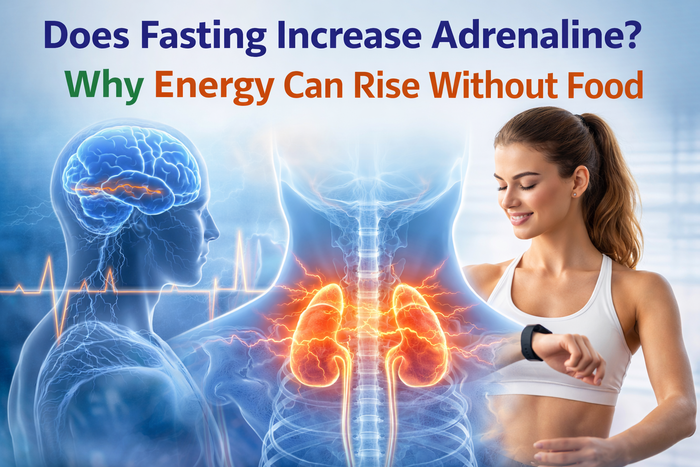
Many people assume that not eating should make you tired. Yet during fasting, some individuals report feeling more alert, focused, and energized.
Why does this happen?
One reason is adrenaline — also known as epinephrine.
Let’s break it down logically.
What Is Adrenaline?
Adrenaline (epinephrine) is a hormone released by the adrenal glands.
It is part of your “fight-or-flight” response and works by activating the sympathetic nervous system.
Adrenaline increases:
- Heart rate
- Blood flow to muscles
- Blood sugar availability
- Mental alertness
- Fat breakdown
Its primary role is survival — helping your body respond quickly to stress or energy demands.
Does Fasting Increase Adrenaline?
Yes, short-term fasting can increase adrenaline levels.
When you stop eating, your body recognizes that incoming fuel has decreased. To maintain energy supply, it activates compensatory mechanisms.
One of those mechanisms is a mild increase in:
- Adrenaline (epinephrine)
- Norepinephrine
- Sympathetic nervous system activity
This is not panic mode. It is controlled metabolic activation.
The goal is simple: mobilize stored energy.
Why Energy Can Increase Without Food
When adrenaline rises during fasting, it helps:
- Break down stored fat into fatty acids
- Release glucose from the liver
- Maintain blood pressure
- Increase mental focus
From an evolutionary perspective, this makes sense.
If humans became weak and sleepy when food was unavailable, survival would have been difficult. Instead, the body increases alertness to encourage food-seeking behavior.
That’s why many people feel sharp and productive during short fasts.
Is This a Stress Response?
Technically, yes — but not necessarily a harmful one.
Fasting is a mild physiological stressor. The body responds with adaptive stress hormones, including adrenaline and sometimes cortisol.
In healthy individuals:
- The increase is moderate
- It is temporary
- It supports energy balance
Problems are more likely when fasting is extreme, prolonged, or combined with poor sleep and chronic stress.
Context matters.
Adrenaline vs. Cortisol During Fasting
Both are stress-related hormones, but they behave differently.
Adrenaline:
- Acts quickly
- Raises alertness
- Mobilizes immediate energy
Cortisol:
- Acts more gradually
- Supports longer-term glucose regulation
- Influences metabolism over hours
A temporary rise in adrenaline does not automatically mean your body is “burning out.” It is part of a coordinated hormonal response.
When Might It Become a Problem?
You may need caution if:
- You already have chronic anxiety
- Sleep quality is poor
- Calorie intake is extremely low
- You feel wired but exhausted
In those cases, fasting may amplify sympathetic activation more than desired.
Energy should feel steady and focused — not jittery.
Practical Takeaway
Yes, fasting can increase adrenaline slightly.
This rise helps:
- Release stored energy
- Maintain blood sugar
- Improve alertness
- Support fat burning
Feeling energized during short-term fasting is often a normal adaptive response — not a sign of danger.
However, balance remains key. Fasting should feel sustainable, not stressful.