

What Is Habit Hunger?
Have you ever noticed that you feel hungry at the same time every day — even if you ate a large meal earlier?
That feeling is often not true energy deficiency. It’s something called habit hunger.
Habit hunger happens when your brain expects food at a certain time because you’ve trained it to do so. Over time, your body learns patterns. If you regularly eat lunch at 1:00 PM, your brain begins preparing for food before that time arrives.
This preparation creates the sensation of hunger — even if your energy stores are still adequate.
How Hormones Create Hunger Timing
Hunger is not random. It is regulated by hormones.
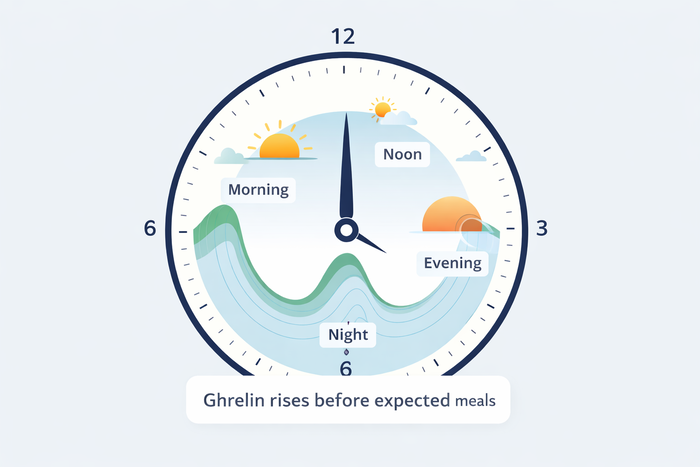
One of the main short-term hunger hormones is ghrelin. Ghrelin rises before expected meal times and drops after eating.
Research shows that ghrelin levels increase in anticipation of food — not just in response to low energy.
That means if you eat breakfast at 8:00 AM every day, ghrelin begins rising around that time automatically.
This is why:
- You can feel hungry “on schedule”
- Hunger can disappear if you ignore it for a while
- Skipping a usual meal time feels uncomfortable at first
Your body isn’t necessarily low on fuel. It is responding to a learned rhythm.
The Role of Your Internal Clock (Circadian Rhythm)
Your body runs on a 24-hour internal clock called the circadian rhythm.
This clock regulates:
- Sleep
- Hormones
- Body temperature
- Metabolism
- Hunger timing
When you eat at consistent times, your circadian system aligns digestion and hormone release to those patterns.
If you suddenly change your eating schedule — such as starting intermittent fasting — hunger initially appears at your old meal times. But after several days, those hunger waves usually shift.
Your internal clock adapts.
Is It Real Hunger or Just a Signal?
True physiological hunger usually develops gradually and is accompanied by:
- Low energy
- Difficulty concentrating
- Stomach sensations
- Irritability over time
Habit hunger, on the other hand:
- Appears suddenly
- Follows the clock
- Often fades if ignored for 20–30 minutes
This explains why hunger sometimes feels intense — but then disappears without eating.
The sensation was hormone-driven anticipation, not energy crisis.
Does Fasting Reset Hunger Timing?
Yes — over time.
When you begin fasting or change meal timing, ghrelin still rises at your old schedule. But if you consistently delay eating, ghrelin peaks begin to shift.
Studies show that hunger waves adapt within several days to a few weeks.
This is why:
- The first week of fasting feels hardest
- Hunger becomes more predictable
- Cravings often decrease with consistency
Your body is highly adaptable.
Why This Matters
Understanding habit hunger removes fear.
Many people assume that hunger always means:
- Blood sugar is dangerously low
- Metabolism is slowing
- The body is “starving”
In reality, much of daily hunger is rhythmic and conditioned.
Recognizing this can help you:
- Avoid unnecessary snacking
- Transition into structured meal timing
- Reduce anxiety around fasting
Practical Takeaway
If you feel hungry at the same time every day, pause before reacting.
Ask yourself:
- Did I truly eat too little?
- Or is this my body expecting food?
Wait 20–30 minutes. Drink water. Stay busy.
If hunger fades, it was likely habit hunger.
If it intensifies gradually, your body may genuinely need fuel.
Learning the difference builds metabolic awareness — not restriction.