
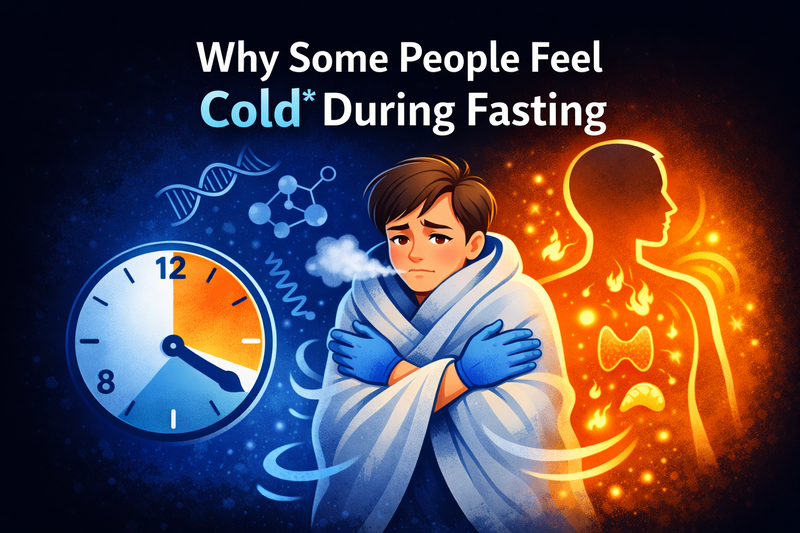
Many readers wonder why some people feel cold during fasting while others feel completely normal. If you feel cold during fasting, you’re not alone.
Some people notice cold hands, cold feet, chills, or lower body warmth when they skip meals or extend their fasting window. Others feel completely normal. That difference can be confusing.
Many people assume feeling cold means their metabolism is slowing down. But in many cases, it may simply be your body reacting to lower food intake, less heat production, and changes in energy use.
Why fasting can make you feel cold
When you eat, your body produces heat while digesting food. This is sometimes called the thermic effect of food. During fasting, that heat-producing effect drops because no food is coming in.
At the same time, your body may shift into a more energy-conserving mode, and stress-related hormone changes may also play a role. If you want a deeper look at that side of fasting, read our guide on why fasting can increase cortisol.
- your fasting window is long,
- you’re eating fewer calories overall,
- you’re already lean,
- or you’re under stress.
That can make you feel colder than usual.
Is it because of hormones?
That can make you feel colder than usual. Stress-related hormone changes may also play a role, which is why some people notice symptoms like chills or feeling “off” during a fast. If you want a deeper explanation, read our guide on why fasting can increase cortisol.
Some researchers have looked at orexin, a brain chemical involved in:
- appetite
- alertness
- energy balance
- body temperature regulation
Animal research suggests orexin may affect how body temperature responds during fasting. This may help explain why some people feel very cold, while others barely notice anything. If you want the bigger picture of these fasting changes, read our guide on what happens in the body during a fast.
But here’s the key:
Feeling cold does NOT automatically mean “fat burning is happening”
That’s a popular claim online, but it’s too simplistic.
Fasting can increase fat use, yes—but feeling cold is not a reliable proof of fat burning on its own.
A more realistic explanation is:
- less meal-generated heat
- changes in thermogenesis
- lower energy availability
- individual hormone sensitivity
Why Some People Feel Cold During Fasting
Your response to fasting depends on things like:
- body fat level
- muscle mass
- sleep quality
- stress
- thyroid function
- blood sugar stability
- what you ate before the fast
Your response to fasting depends on things like body fat, sleep, stress, and hormone signaling. If you want another example of how these signals shift during a fast, read our guide on how fasting affects leptin.
That’s why two people can do the same fast and feel completely different.
Can coffee help?
Sometimes, yes.
Black coffee or plain tea may help because:
- it’s a warm drink,
- caffeine can increase alertness,
- and some people feel less cold after it.
A quick walk or light movement can also help.
When should you be careful?
Mild coldness can be normal.
But if fasting makes you feel:
- dizzy
- shaky
- weak
- sweaty and cold
- mentally foggy
- close to fainting
Medical experts also note that intermittent fasting can cause side effects in some people, especially if the fasting approach is too aggressive. Harvard Health outlines several common intermittent fasting side effects to watch out for.
Bottom line
Feeling cold during fasting is common for some people and doesn’t always mean something is wrong.
In many cases, it may simply reflect:
- less heat from digestion,
- changes in energy use,
- and your body’s unique response to fasting.
If it’s mild, it may be manageable.
If it feels intense or comes with weakness or dizziness, it’s a sign to stop and reassess.
Q&A
Why do I feel cold when fasting?
Because your body produces less heat without food, and fasting may change how your body uses energy.
Does feeling cold during fasting mean I’m burning fat?
Not necessarily. It may happen during fasting, but it’s not a guaranteed sign of fat burning.
Can coffee help if I feel cold while fasting?
Yes, sometimes. A warm drink plus caffeine may help some people feel warmer.
Should I stop fasting if I feel very cold?
If it’s mild, it may be normal. If it comes with dizziness, weakness, or shakiness, stop and reassess.